How can you lose weight after 35 when the numbers on the scale no longer change as easily as they used to? This is a question we often hear from EMS Miha clients in Kyiv. A few years ago, cutting back on sweets and adding a few workouts might have been enough to see quick changes. After 35, the same approach may not work quite as well.
You may feel like your body has become "slower." Your stomach and sides may respond more quickly to changes in your diet, while losing those extra kilograms becomes more difficult. At the same time, there is often less time for exercise: work, family, children, and an endless list of daily responsibilities.
But it is not because the body suddenly stops losing weight after 35.
Weight loss is still determined by energy balance: if your body consistently receives less energy than it expends over time, body fat will gradually decrease. The real question is how to organize this process so that you primarily lose fat, maintain muscle mass, and do not have to build your entire lifestyle around spending hours in the gym.
This is where EMS can become a practical tool.
Why Can Losing Weight Become More Difficult After 35?
Let's start with a common myth. Your metabolism does not automatically "break down" after the age of 35.
A study published in Science found that daily energy expenditure, when adjusted for body composition, remained relatively stable in adults from approximately age 20 to 60. In other words, turning 35 is not a physiological boundary after which your body suddenly starts burning significantly fewer calories.
So why do so many people notice changes after 35?
The answer is often lifestyle.
We move less, sit more, exercise less frequently, and gradually lose muscle mass if we do not give our bodies enough strength-training stimulus.
Add insufficient sleep, stress, irregular meals, and less free time, and you can easily end up in a situation where your usual diet no longer matches your new level of daily activity.
So after 35, the better question is not: "How can I boost my metabolism?"
It is:
"How can I organize my nutrition, movement, and training to create a calorie deficit, preserve muscle, and achieve a result I can actually maintain?"
How to Lose Weight After 35: A Calorie Deficit Is Still the Foundation
Whatever training method you choose, a calorie deficit is necessary to reduce body fat.
This means that, on average over a period of time, your body uses more energy than it receives from food.
You do not need to drastically cut your calorie intake. Extremely restrictive diets are often difficult to maintain, and rapid weight loss can involve losing not only body fat but also muscle tissue.
After 35, this is particularly undesirable.
Our goal is not simply to see a lower number on the scale, but to improve body composition: gradually reduce body fat while preserving as much muscle as possible.
That is why your diet should be based on nutritious foods, adequate protein, vegetables, fiber, and a controlled calorie intake.
Training, meanwhile, provides an additional stimulus for your muscles.
EMS After 35: Why Muscle Becomes Especially Important
When you lose weight, your body does not lose only fat. Under unfavorable conditions, muscle mass can decrease as well.
This is why strength training plays an important role in weight-management programs.
Muscle is not only about appearance. It supports movement, strength, and physical function.
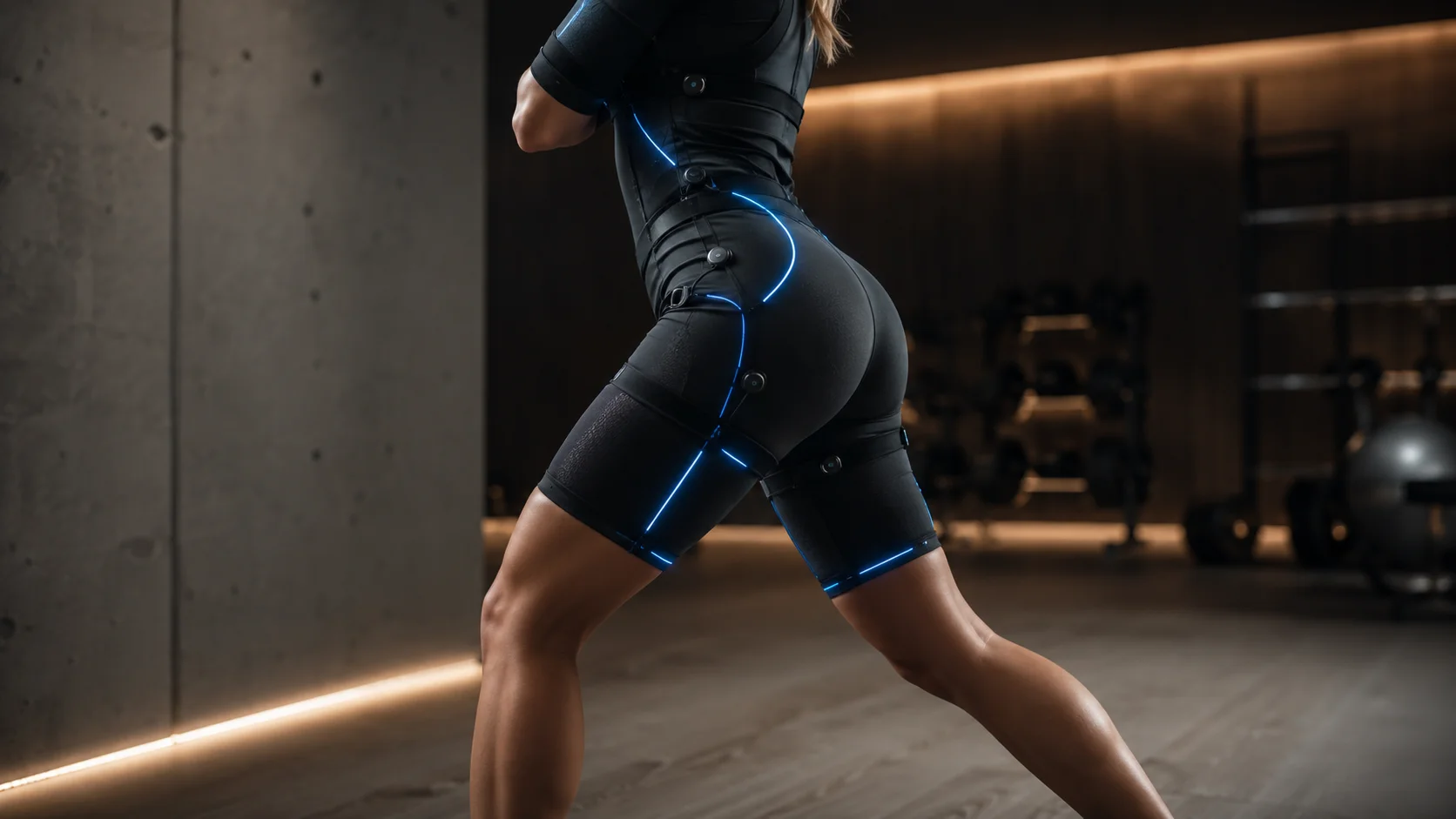
EMS training uses electrical impulses to stimulate muscle contractions. With whole-body EMS, large muscle groups can be engaged simultaneously.
During a session, you are not simply lying still. You perform exercises while EMS adds an additional layer of muscle stimulation.
Scientific reviews of whole-body EMS show the most consistent positive results in terms of muscle strength and muscle mass. Evidence regarding direct reductions in body fat is less consistent. That is why we do not view EMS as a "fat burner" that works independently of nutrition.
A more accurate way to put it is this: EMS can be one tool within a training program that helps you work on your muscles while changing your body composition.
How Can EMS Help You Lose Weight After 35 If You Have No Time for the Gym?
After 35, many people share one common problem — time.
You may understand that you need to exercise, but finding 60–90 free minutes several times a week can be difficult.
This is where EMS offers a practical advantage.
At EMS Miha, the main part of the workout takes around 20 minutes.
Your trainer helps you prepare your equipment, adjusts the intensity of the impulses, and guides you through a structured exercise routine.
For many clients, a convenient schedule is 2 workouts per week.
That adds up to approximately 40 minutes of main training time per week.
Of course, this does not mean that 20 minutes of EMS is automatically equivalent to an hour of any other type of exercise. Different forms of physical activity cannot be compared that simply.
The advantage of EMS lies elsewhere:
you get a structured workout in a short amount of time, making it easier to realistically fit exercise into a busy schedule.
And when it comes to results, consistency matters.
What Does an EMS Workout After 35 Look Like at EMS Miha?
The first stage is preparation.
You put on specialized functional equipment, after which your trainer connects the system and adjusts the intensity.
We do not use the same impulse intensity for every area or every person.
Muscles can respond differently to stimulation, so the intensity is adjusted individually.
You may feel a light tingling sensation followed by rhythmic muscle contractions. As the intensity increases, the muscle work becomes more noticeable.
Then the active part begins.
Squats, lunges, planks, core exercises, and full-body movements.
You perform the exercises yourself, control your body position, and follow the trainer's instructions while EMS complements the workload.
After 35, this can be especially convenient for people who want to stay physically active but are not willing to spend several evenings every week at the gym.
Can You Lose Weight Quickly After 35 With EMS?
If by "quickly" you mean losing several kilograms in one week, the answer is that should not be your goal.
Your weight can change rapidly because of fluctuations in body fluids and glycogen stores, but that is not the same as losing body fat.
Sustainable results come from gradually changing body composition, not from maximizing the speed at which the number on the scale decreases.
EMS can help you establish regular training, but successful weight loss requires a comprehensive approach.
You can think of it like this:
calorie deficit → reduction in body fat;
strength training → stimulus for muscle;
daily activity → additional energy expenditure;
sleep and recovery → the ability to consistently follow your plan.
EMS plays a role specifically within the training component of this system.
How to Lose Weight After 35 Without Losing Muscle
This question is often underestimated.
Someone sees 5 kg less on the scale and feels happy. But the number itself does not tell you how much of that weight came from fat and how much came from water or muscle tissue.
For meaningful body transformation, body composition matters just as much as body weight.
That is why after 35, we recommend paying attention to several key factors:
adequate protein intake;
regular strength training;
a moderate rather than extreme calorie deficit;
sufficient daily physical activity;
sleep and recovery.
EMS can be one option for providing a strength-training stimulus.
But it should not be the only thing you rely on.
The more varied your physical activity, the better it is for your overall fitness.
Walking, swimming, cycling, traditional strength training — all of these can complement your program.
What to Do to Lose Weight After 35: A Practical Checklist
1. Review Your Diet
Do not start with an extreme diet. Start by analyzing what you actually eat throughout the day.
Pay attention to hidden calories: sugary drinks, alcohol, snacks, large portions, and frequent "little" desserts.
2. Add Strength Training
Your muscles need regular stimulation. This can come from EMS or traditional strength training.
3. Train Consistently
For EMS, a practical format can be 2 sessions per week, around 20 minutes each, with sufficient recovery between workouts.
4. Move More Throughout the Day
Do not limit your physical activity to your workouts.
Daily walking and movement throughout the day also contribute to your overall energy expenditure.
5. Get 7–9 Hours of Sleep
Adults are generally recommended to get at least 7 hours of sleep per night, although individual needs may be higher.
6. Measure Your Progress Correctly
Your body weight is only one measurement.
Track your waist circumference, take progress photos under similar conditions, and pay attention to changes in your physical performance and body shape.
Sometimes your body can visibly change before your weight reaches your target number.
Weight Loss After 35: What Can EMS Really Do?
To be completely honest, EMS is not a magic solution for losing weight after 35.
It does not eliminate the need for a calorie deficit. It does not replace daily physical activity. It does not allow you to selectively burn fat from your stomach.
But EMS can be useful if you want to:
train in a short amount of time;
maintain consistency;
work on muscle strength;
engage large muscle groups;
exercise under the supervision of a trainer;
make training a realistic part of a busy schedule.
Consistency is often the biggest advantage.
The best workout is not the one you plan to "start someday." It is the one you can realistically keep doing week after week.
EMS Miha in Kyiv: How to Start Losing Weight After 35 Without Spending Hours at the Gym
If you are over 35, want to lose weight, but do not want to spend your evenings at the gym, EMS can be a convenient way to get started.
At EMS Miha in Kyiv, you train under the supervision of a trainer, use professional Miha Bodytec equipment, and the main part of the workout takes around 20 minutes.
For many clients, the optimal schedule is 2 workouts per week.
And then the system starts working.
Nutrition creates the conditions for a calorie deficit. Training helps you work on your muscles. Daily activity increases your overall energy expenditure. Sleep and recovery help you maintain the routine.
You do not need to wait for Monday or for the "perfect moment."
Book a trial EMS workout at EMS Miha and discover how 20-minute sessions can fit into your schedule and become part of your weight-loss plan after 35.