At 7:30 PM, you close your laptop. Ahead of you are the commute home, dinner, and household chores. Going to the gym takes at least an hour and a half, including travel time. Or there’s simply no time left at all. That’s exactly why EMS training has become popular among people who want to stay in shape without spending several evenings a week at a fitness club.
As EMS has grown in popularity, so have the myths surrounding it. Some studios claim a 20-minute EMS session can replace the gym entirely, while others market EMS as a universal weight-loss solution. As usual, the truth lies somewhere in between.
Let’s separate facts from marketing claims. Here’s what physiology actually tells us.
First, How EMS Works
If we simplify the process as much as possible, there’s nothing mysterious about it.
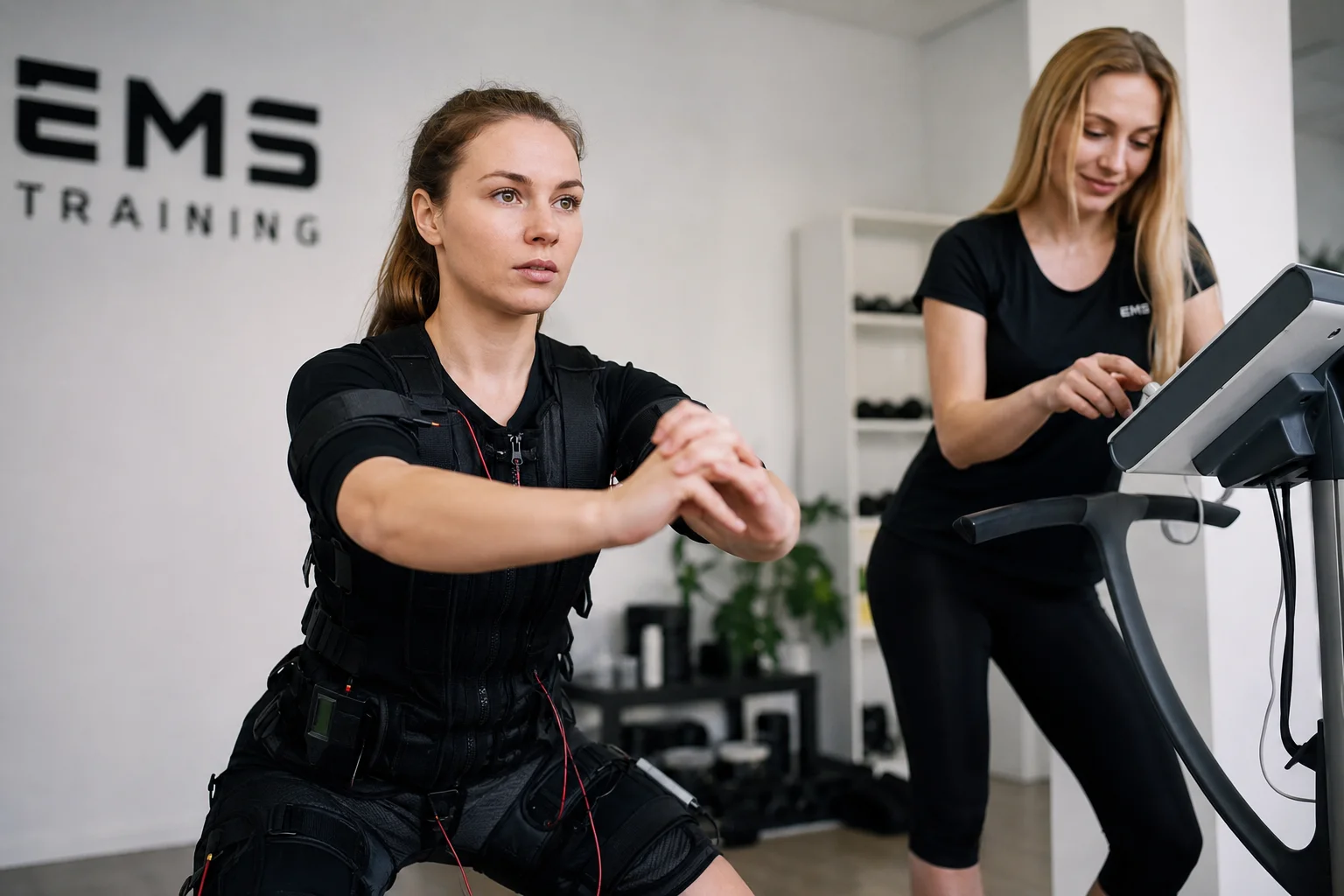
An EMS suit delivers an electrical impulse. The muscle responds by contracting. At the same time, the person performs an exercise—such as squats, lunges, or a plank.
You’ll often hear that electricity "works instead of your muscles." That’s simply not true.
It merely enhances the nerve signal and helps recruit more motor units—the neuromuscular structures responsible for activating muscle fibers. Everything else is done by your own body. EMS does not create an alternative form of human physiology.
That’s why this technology can enhance a workout, but it cannot override the fundamental principles of how the body adapts to exercise.
Myth #1. EMS Completely Replaces the Gym
This is the foundation of much of the marketing around EMS.
Yes, EMS is very effective at making muscles contract. That is its greatest strength.
However, there’s one important limitation. Developing maximum strength requires mechanical load—the weight of a barbell, dumbbells, or even your own body. This mechanical tension triggers most of the physiological processes responsible for increasing strength and muscle hypertrophy.
Electrical impulses cannot replace that.
EMS is an excellent option if:
you have very little time for exercise;
you're returning to training after a long break;
you want to maintain your current fitness level;
you’d like to add variety to your strength-training routine.
However, if your goal is to prepare for a marathon, powerlifting, or bodybuilding, EMS alone will not be enough.
Myth #2. Twenty Minutes Equals a Two-Hour Workout
This is where marketing often blurs the line between intensity and effectiveness.
Yes, a standard EMS session lasts about 20 minutes.
Yes, the workout feels significantly more intense.
But that does not mean your body adapts three times faster.
Your muscles still need time to recover. That’s why most EMS programs recommend only one or two sessions per week with a recovery period of 48–72 hours.
There are some things that no technology can replace:
consistency;
adequate protein intake;
7–9 hours of sleep;
progressive overload;
proper nutrition.
Without these fundamentals, rapid progress simply won’t happen.
Myth #3. EMS Burns Fat by Itself
This is perhaps the biggest exaggeration in EMS advertising.
Electrical stimulation does not "melt" body fat. That’s simply not how the human body works.
After an EMS workout, energy expenditure does increase. Part of this is due to the EPOC effect (Excess Post-exercise Oxygen Consumption), meaning your body continues consuming more oxygen after exercise. Depending on workout intensity, this effect may last anywhere from 12 to 24 hours.
However, there’s an important catch.
If you consume more calories than you burn, body fat will not disappear simply because you trained in an EMS suit.
Physiology makes no exceptions.
Myth #4. EMS Is Suitable for Everyone
No.
In fact, this is something that should always be evaluated before your very first session.
A qualified trainer will never begin your workout two minutes after meeting you. They should first ask about your medical history and current health. If they don't, it's worth questioning the professionalism of the studio.
Main Contraindications
Pacemaker
Implanted defibrillator
Pregnancy
Epilepsy
Acute infectious diseases
Decompensated cardiovascular disease
Acute thrombosis
Cancer without physician approval
Open skin injuries where electrodes are placed
If you have any chronic medical conditions, consult your physician before starting EMS training.
Myth #5. EMS Is Equally Effective for Everyone
That would certainly be convenient. But the human body is far more complex.
The same training program does not guarantee the same results for everyone.
Progress depends on many factors, including:
age;
current fitness level;
nutrition;
protein intake;
sleep quality;
hormonal balance;
genetics.
That’s why beginners often notice changes much faster than experienced athletes.
EMS vs. Traditional Strength Training: Which Should You Choose?
Criteria | EMS Training | Traditional Strength Training |
|---|---|---|
Session duration | About 20 minutes | 60–90 minutes |
Frequency | 1–2 times per week | 3–5 times per week |
Maximum strength development | Limited | High |
Simultaneous muscle activation | High | Depends on the program |
Best choice when short on time | Yes | Not always |
How to Tell Whether You're Buying a Workout—or Just Promises
Before signing up, ask a few simple questions.
What equipment does the studio use?
Does every client undergo an initial health screening?
How is the impulse intensity adjusted?
Why do they recommend only one or two sessions per week?
What results can realistically be expected after one month, and which take three months or longer?
If all you hear is "Lose 10 kg in a month" or "Completely replace the gym," it's probably worth looking for another studio.
If You're Looking for EMS Training in Kyiv
Don't choose a studio based solely on the price of a single session.
Instead, focus on three things: who conducts the training, what equipment the studio uses, and whether they perform an initial health assessment.
Most EMS fitness studios in Kyiv follow a similar training principle. The real difference lies not in the electrical impulses, but in the trainer’s qualifications, proper equipment calibration, and an individualized approach.
Conclusion
EMS does not change human physiology. It simply allows you to use your training time more efficiently.
If you can't spend four evenings a week in the gym, EMS can be an excellent way to maintain your physical fitness. However, if your goal is to maximize strength, prepare for competition, or systematically build muscle mass, traditional strength training remains the gold standard.
Rather than viewing EMS and the gym as competitors, think of them as different tools designed for different purposes. The key is choosing the one that best matches your goals, lifestyle, and health.
If you'd like to learn more about choosing the right training format, we recommend reading "EMS or gym: what to choose when you have limited time?"